
Toronto, Ontario, May 20, 2026 – ONGold Resources Ltd. (the “Company” or “ONGold”) (TSXV: ONAU) (OTCQB: ONGRF) is pleased to announce the commencement of its 2026 Phase 1 field exploration program at the Ti-pi-ha-kaa-ning (“TPK”) project, located in Northern Ontario.
The TPK claims are located on the regional communities’ winter road network, which connects directly to the Musselwhite Gold Mine access road north of Pickle Lake (Figure 1). The 2026 program will initially focus on the Gold Ridge area, including the Discovery Zone and the West Discovery Copper-Silver-Gold Zone (“West Discovery Zone”), where ONGold’s 2025 diamond drilling program returned high-grade gold, copper and silver mineralization.
The Phase 1 June field program is designed to enhance ONGold’s geological understanding for the Gold Ridge area and advance priority targets for a planned Phase 2 drill program later in the 2026 field season. Phase 2 drilling is currently expected to commence in August or September, following receipt of the interpretation and integration of the Phase 1 geophysical, mapping and prospecting results.
2026 Field Program Highlights
The Phase 1 exploration program is expected to include:
Ground Geophysical Surveys at Gold Ridge
- A ground electromagnetic survey (Fixed Loop TDEM) over and around the West Discovery Zone, designed to test for possible extensions of the recently intersected massive sulphide mineralization and assist in defining conductive trends and structural controls associated with copper-silver-gold mineralization.
- A ground gravity survey over the Gold Ridge area, including the Discovery Zone and West Discovery Zone, to assist in defining bedrock geology, structural architecture and potential intrusive contacts associated with mineralization.
Focused and Reconnaissance Geological Mapping and Prospecting
- Detailed geological and structural mapping in the Gold Ridge area to improve ONGold’s understanding of host rocks, alteration, deformation and mineralization controls.
- Prospecting and sampling along the inferred strike extent of the Discovery Zone and West Discovery Zone.
- Prospecting of newly prioritized targets generated from ongoing geological compilation work.
- Initial reconnaissance prospecting on recently staked ground within the broader TPK property package (see press release dated November 24, 2025) and along a newly exposed 20-metre-wide fibre optic line excavation that transects the central portion of the property on a north–south orientation.
Orientation Soil Survey To evaluate soil sampling as an exploration tool to identify anomalous gold trends across the TPK property and to prioritize prospective structural targets for follow-up field work and potential drill testing.
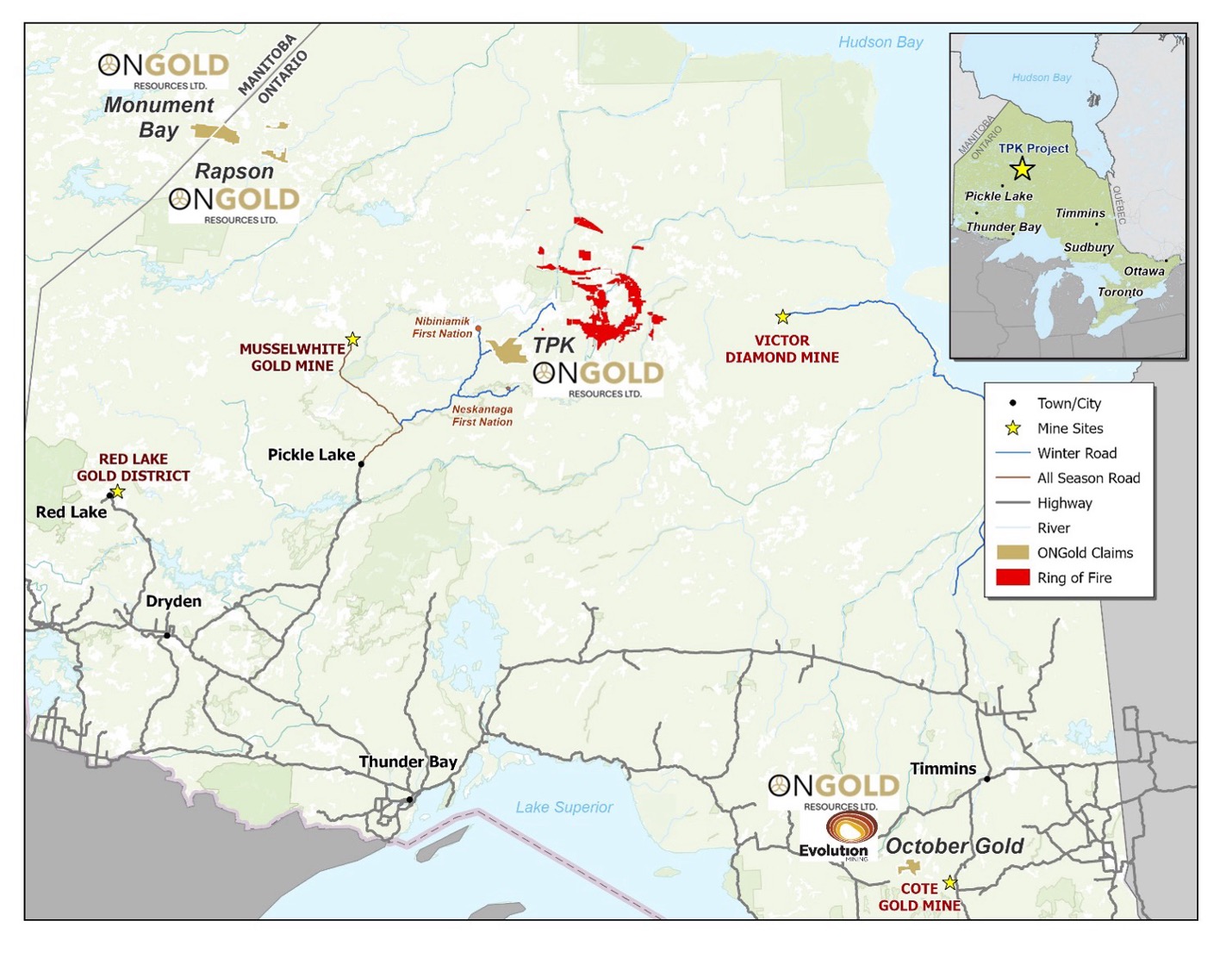
Figure 1 Location map of the TPK project in northern Ontario
Kyle Stanfield, CEO and a director of ONGold, commented: “Following the very successful 2025 drill program at Gold Ridge, and ongoing compilation work, we are pleased to begin our 2026 field season at TPK. The Phase 1 program is intended to sharpen our geological interpretation of the Gold Ridge area through ground geophysics, mapping and prospecting, and to enhance targeting of the Phase 2 drilling planned for later this season. The 2025 drilling confirmed high-grade gold mineralization at the Discovery Zone and copper-silver-gold mineralization at the West Discovery Zone (Figure 2). Our objective now is to integrate the new field data with the 2025 drill results and historical work to prioritize the next round of drill targets.”
Gold Ridge 2025 Drill Results Informing the 2026 Program
The 2026 exploration program follows ONGold’s recently completed nine-hole (holes GR-25-008 to GR-25-016), 2,169-metre diamond drilling program in the Gold Ridge area of the TPK project. Results from the 2025 program confirmed a mineralized and structurally complex system, with high-grade gold, copper and silver intersections returned from both the Discovery Zone and the West Discovery Zone.
Highlights from the 2025 drilling program included:
West Discovery Copper-Silver-Gold Zone
- Hole GR-25-012 previously intersected 3.06% Cu, 60.3 g/t Ag and 1.50 g/t Au over 1.5 metres (318.5 – 320.0m), including 11.1% Cu, 218 g/t Ag and 4.45 g/t Au over 0.4 metres, in an east-trending shear zone (see the Company’s news release dated January 19, 2026).
- Hole GR-25-013 previously intersected 2.95% Cu, 42.4 g/t Ag and 1.79 g/t Au over 0.3 metres (157.8-158.1m) (see the Company’s news release dated January 19, 2026).
- Hole GR-25-013 also previously returned 0.96% Cu, 20.6 g/t Ag and 0.97 g/t Au over 0.4 metres (294.6-295.0m), interpreted to align on strike approximately 110 metres east of the high-grade copper zone intersected in GR-25-012 (see the Company’s news release dated January 19, 2026).
Discovery Zone
- Hole GR-25-011 returned a previously reported intercept of 19.39 g/t Au and 1.0 g/t Ag over 8.2 metres (11.8-20.0m), including 308 g/t Au and 14.6 g/t Ag over 0.3 metres (see the Company’s news releases dated November 4, 2025 and January 19, 2026).
The 2025 results are interpreted to indicate the presence of an intrusive-hosted, orogenic-style copper-gold system in the Gold Ridge area. Mineralization remains open, and the approximately 1,500-metre corridor between the Discovery Zone and the West Discovery Zone remains largely untested by drilling. All reported intervals are downhole core lengths. True widths are unknown at this time and will be refined with additional structural and geometry work.
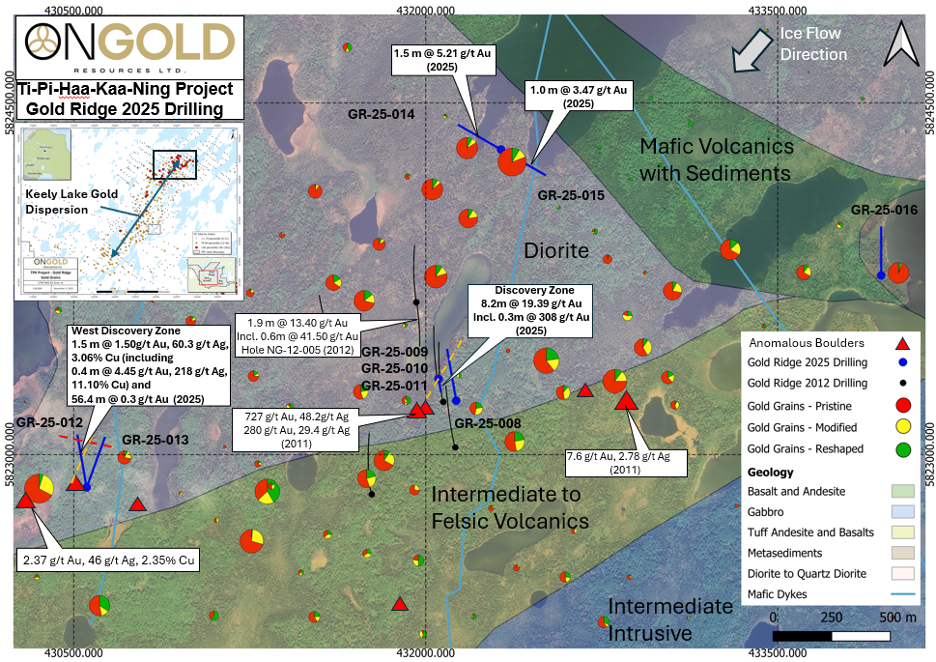
Figure 2 Gold Ridge area historical gold grains in till results, interpreted geology, historical (black drill holes) and recent drilling (blue drill holes).
Next Steps
Following completion of the Phase 1 June field program, ONGold expects to compile and interpret results from the ground geophysical surveys, geological mapping, prospecting and sampling programs. These results will be integrated with historical exploration data, 2025 drill results and ongoing geological compilation work to refine priority targets for Phase 2 diamond drilling later in the 2026 field season.
The planned Phase 2 drill program is expected to test extensions of known mineralization at the Discovery Zone and West Discovery Zone, as well as additional targets prioritized through the Phase 1 program.
TPK Infrastructure Improvement During the winter of 2026, a local First Nations-led fibre optic construction program expanded the regional network. The network expansion included a new 20-metre-wide and 19-kilometre-long access corridor (Figure 3) with a buried fibre optic cable alignment extending from the south boundary of the TPK claims north to the existing winter access road (Figure 4). During a site inspection in March 2026, ONGold observed that heavy equipment excavation along the corridor had exposed numerous bedrock outcrops in proximity to the West Discovery Zone and elsewhere. ONGold expects to assess the corridor during the June Phase 1 field program, including prospecting and sampling.
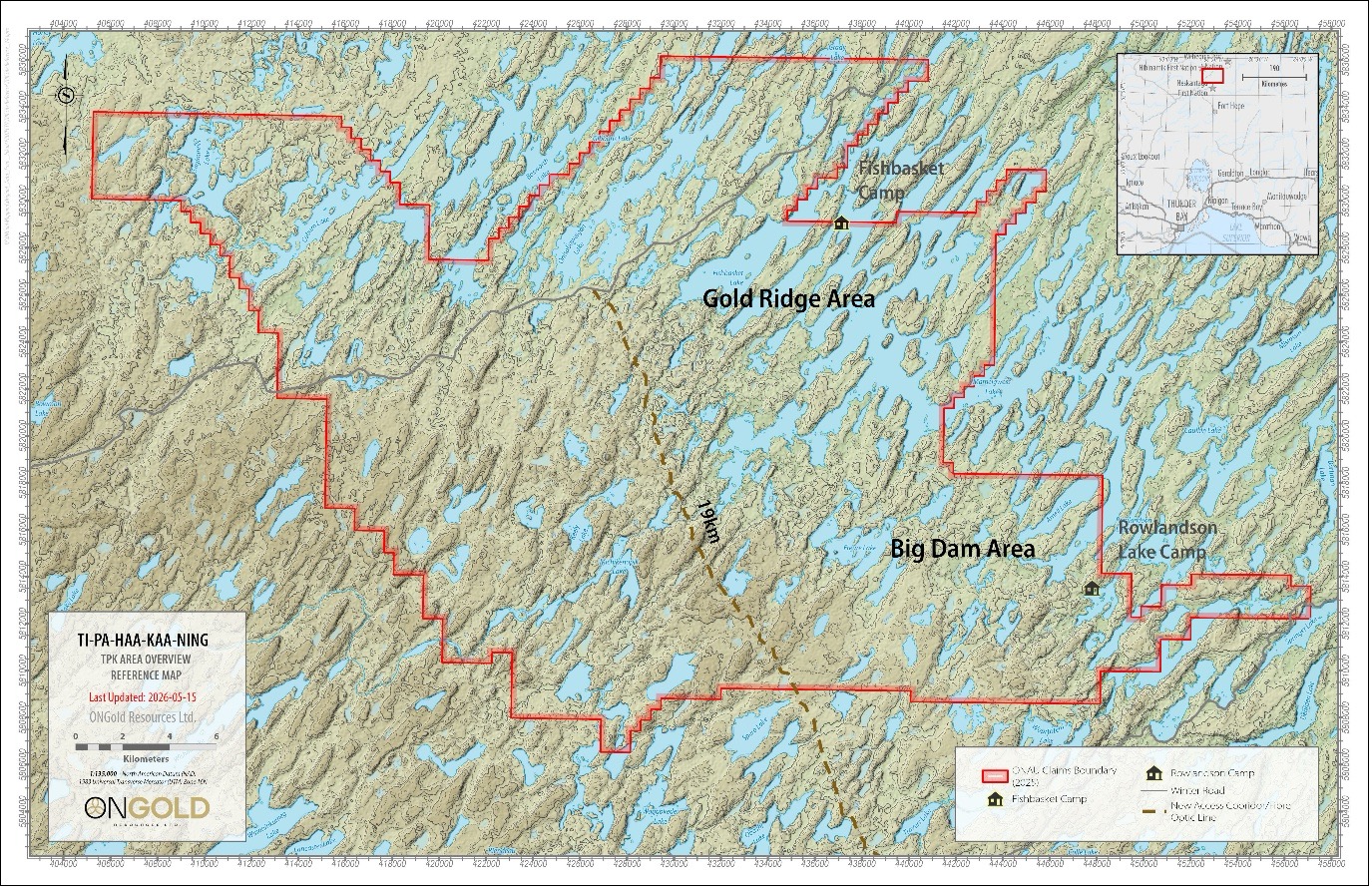
Figure 3 New access corridor location.
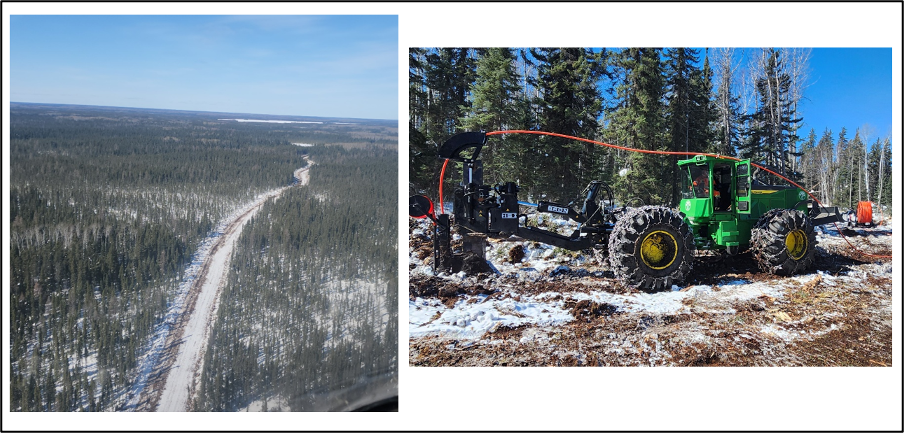
Figure 4 New access corridor and buried fibre optic cable installation on TPK claims, March 2026.
Qualified Person
The scientific and technical information in this news release has been reviewed and approved by Paul Dunbar, P.Geo., Vice President Exploration of ONGold, a “Qualified Person” as defined in NI 43-101 – Standards of Disclosure for Mineral Projects (not independent). Limitations: the QP has not verified all underlying historical data for the entire TPK dataset and verification is limited to the referenced drill holes. Ongoing verification of scientific and technical information is achieved by direct involvement in the exploration work.
QA/QC and Assay Procedures
Quality Assurance/ Quality Control (“QA/QC”) procedures were executed to ensure all work is conducted in accordance with best practices. Drill core was cut in half with one half of the core prepared for shipment and the other half retained for future verification. Samples were placed into security-sealed bags for shipment. Drill core is BQTK size and sample intervals range from 0.3 metres to 1.5 metres in length. Commercially prepared certified reference material (“CRM”) standards and blanks were inserted at a rate of 1 QA/QC sample in every 10 core samples.
Samples were analyzed at Activation Laboratories facility in Thunder Bay, Ontario and Ancaster, Ontario which are ISO 17025 and ISO 9001 certified. Samples were initially analyzed by 50-gram fire assay with atomic absorption finish. Any sample assaying greater than 5 g/t Au was re-assayed by fire assay gravimetric analysis. Selected samples have been analyzed by screened metallics method.
Geochemical analyses were performed by Activation Laboratories and consist of aqua regia digestion and analyses for 38 elements by ICP. Overlimit samples are re-assayed for silver and copper by Aqua Regia digestion using Inductively Coupled Plasma Optical Emission Spectroscopy (“ICP-OES”), Actlabs code “8 – AR – ICP-OES”. A 0.5g sample is digested in aqua regia and diluted volumetrically to 250 ml with 18 megaohm water. Certified reference materials for the appropriate elements are digested the same way and are used as a verification standard(s). Samples are analyzed on an ICP-OES.
About ONGold Resources Ltd.
ONGold Resources Ltd. owns significant exploration assets in Northern Ontario and Northern Manitoba, including the district-scale Monument Bay Gold and Tungsten Project, TPK Project, Domain Gold Project and October Gold Project. These projects represent a strategic footprint in one of Canada’s most prolific gold-producing regions.
With its extensive technical expertise, strong commitment to social acceptability, mindful Indigenous engagement and partnerships, in addition to a proven track record of responsible exploration, ONGold’s team is uniquely positioned to unlock the full potential of its portfolio of projects.
ONGold Resources Ltd. on behalf of the Board of Directors
Kyle Stanfield, Chief Executive Officer & Director
Contact Information
Kyle Stanfield
Chief Executive Officer
Telephone: 1-647-749-5836
Email: info@ongoldresources.com
Neither the TSX Venture Exchange nor its Regulation Services Provider (as that term is defined in the policies of the TSX Venture Exchange) accepts responsibility for the adequacy or accuracy of this release.
Cautionary Note Regarding Forward-Looking Information:
This news release contains “forward-looking information” within the meaning of applicable Canadian securities laws. Forward-looking information includes, but is not limited to, statements regarding: the timing, scope and expected results of the Company’s 2026 Phase 1 field exploration program at the TPK Project; the Company’s plans to compile, interpret and integrate Phase 1 results with historical exploration data and prior drill results; the identification, advancement and prioritization of targets; the timing and scope of any planned Phase 2 drilling program later in the 2026 field season; the potential for extensions of known mineralization and the potential to identify additional mineralized zones; and the Company’s expectations regarding the assessment and exploration significance of the newly constructed access corridor and related bedrock exposures. Generally, forward-looking information can be identified by the use of forward-looking terminology such as “plans,” “expects,” “is expected,” “budget,” “scheduled,” “estimates,” “forecasts,” “intends,” “anticipates,” or “believes,” or variations of such words and phrases or statements that certain actions, events or results “may,” “could,” “would,” “might,” or “will be taken,” “occur,” or “be achieved.”
Forward-looking information is based on management’s reasonable assumptions, estimates and expectations as of the date hereof, including assumptions regarding, among other things: access to the TPK Project; weather and seasonal conditions; the availability of personnel, contractors and equipment; the performance of third-party service providers (including geophysical contractors and analytical laboratories); the timing of the receipt and interpretation of exploration results; and the ability to obtain, maintain or renew any permits, approvals or consents that may be required to carry out the Company’s planned exploration activities.
Forward-looking information is subject to known and unknown risks, uncertainties and other factors that may cause actual results to differ materially from those expressed or implied by such forward-looking information. These risks and uncertainties include, but are not limited to: risks inherent in mineral exploration (including that results may not be as anticipated, or may not support further work); geological and interpretation risk; operational and logistical risks (including access, contractor and equipment availability, and supply chain constraints); delays in permitting and regulatory approvals; environmental and community/stakeholder engagement risks; laboratory and analytical delays; commodity price volatility; and general business, economic, competitive and market conditions.
Readers are cautioned not to place undue reliance on forward-looking information. The Company undertakes no obligation to update or revise any forward-looking information, whether as a result of new information, future events or otherwise, except as required by applicable law.